

+34 620 10 75 37info@nanbiosis.com

Blog

Mechanical Characterization of soft biological tissues

The experimental study of the mechanical properties of biological tissues is of vital importance. Thorough research into themechanical response of biomaterials is the basis for the creation ofmodels which can accurately reproduce the mechanical behavior ofsuch materials. Adequate mechanical characterization of tissue materials is of paramount interest to the clinical simulations, diagnostic and tissue engineering fields – where the tissue structure, in contrast to classical mechanics application fields, is just simply a biological tissue.

In order to obtain their material properties, classical engineering testing techniques have been applied to biologicalmaterials. To reproduce the mechanical behavior of these kinds ofmaterial, many constitutive models have been proposed for softtissues (. In some cases, the validation of these models basedon only uniaxial test data is inappropriate because biological andbiomaterial membranes generally develop multiaxial stress statesduring real-life loading conditions.Although a large number of experiments have been conductedover the years on measuring the structural and functional properties of biological tissues, the standardization of such measurementsand the interpretation of results are difficult to establish. The geometry of the sample, the method of gripping the sample edges andthe method used to determine the strain may have profound effectson any measured mechanical properties since they directly influence how the load is transferred to the membrane.

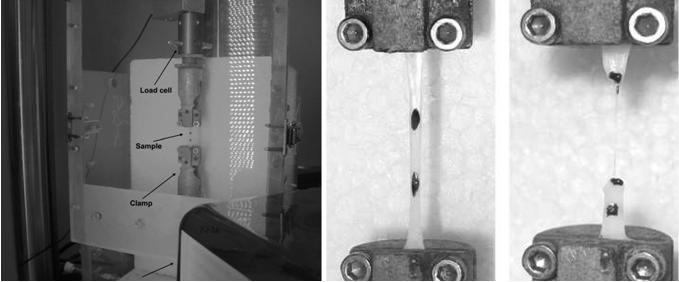
In typical (hard) engineering materials like metals and composites, strain may be measuredat any instance during the mechanical test. Some techniques require a close contact with the samplesduring the test. The use of extensometers attached directly (glued with cyanoacrylateadhesives, for instance) to the gage section of the test specimen, and strain gages thatare mounted directly to the specimen. Sincestrain gages have knife edges to define the exact points of contact with the specimenthey are also incompatible with soft tissues.Imaging techniques such as video extensometry or digital image correlation may be an alternative to the contact methods. Digitalimage correlation (DIC) is based on a process called imagematching. It is possible to use this technique to measure surface displacement and buildup full field 2D and 3D deformation vector fields and in-plane strain maps. It requiresa set of markings, known as speckle, on the analyzed surface(s).Video extensometers performing principle is based on tracking i.e., on following theposition of a given number of markings or regions of interest (ROI).

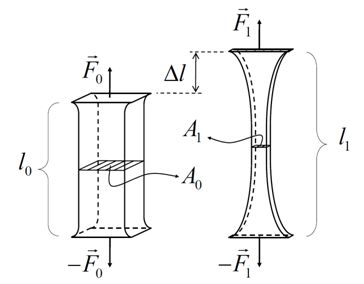
For the particular case of tension tests (uniaxial or biaxial), the physical quantitiesdirectly measurable are the load, F and the elongation, l.These quantities are normalizedto account for the test specimen’sgeometry. The normalizedengineering parameters arethe engineering stress, σ and engineering strain or stretch λ. Engineeringstress is the ratio between theload F and the sample’s crosssection i.e., σ = F/A. Engineeringstrain is given by=l/lo and engineering stretch λ=1+.

Mechanical Characterization of soft biological tissues

Mechanical Characterization of soft biological tissues - Nanbiosis

Creep and relaxation tests are sometimes performed to determine the viscoelastic properties ofsoft tissues; specimen deformation is measured under a constant force in creep testing, whereasin relaxation tests, change in load is determined under constant specimen length. In these tests,stress (= load divided by undeformed specimen cross-sectional area) and strain (= change inspecimen length divided by reference length) are commonly used to represent the data.

Mechanical Characterization of soft biological tissues - Nanbiosis
Read More

Characterization of nanomedicines

The quick development of nanotechnology and its application in medicine have generated new alternatives for the diagnosis and treatment of diseases thanks to the novel methods of preparation, modification and characterization of nanomaterials. The knowledge about the behavior of matter at the atomic and molecular level has allowed the creation of tools and processes to observe manipulate and control biological structures on a scale between 100 and 10,000 times smaller than a mammalian cell.

Nanomedicine is defined as the application of nanotechnology in view of making a medical diagnosis or treating or preventing diseases. It exploits the improved and often novel physical, chemical, and biological properties of materials at nanometer scale.

One of the applications in nanomedicine is diagnostic. Nanodiagnosis consists of developing systems and image analysis techniques both in vivo and in vitro for the early detection of disease, at cellular or molecular level. One of the detection systems developed to date is based on nanoparticles (semiconductor, or magnetic metal) such as quantum dots that are used as cell labeling, identification of tumors or diseased areas. Another line of action within this field is the diagnosis with biosensors or nanobiosensors. These biosensors integrated nanoscale devices for a biological receptor (proteins, DNA, cells) are prepared to specifically detect a substance and a transducer or sensor, capable of measuring biomolecular recognition reaction and translate it into a measurable signal.

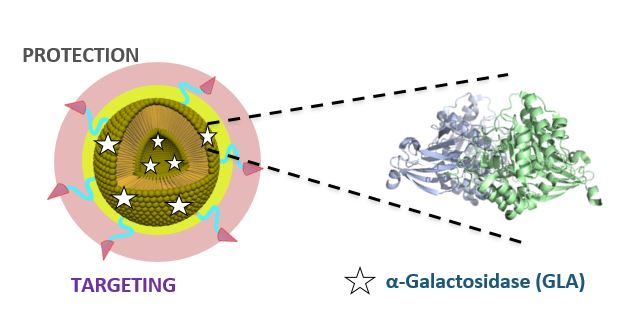
On the other hand, nanomedicine is being investigated as a way to improve the properties of medicines, such as their solubility or stability, and to develop medicines that may provide new ways to target medicines in the body more accurately and to support the Regeneration of cells and tissues. Therapeutic nanosystems research line includes both the development of pharmacological release systems optimized to traverse the blood-brain barrier, and the specific release of enzymes, proteins or gene inhibition strategies by means of siRNA. The development of therapeutic nanoconjugates and of local and controlled release systems for these nanoconjugates, would allow guiding the treatment to the area of action, in the attempt to achieve perfect control of the therapy, preventing the action of the drug or therapeutic particle in areas that might entail a potential risk for the patient.

It is widely accepted that the use of nanotechnology offers impressive potential in the development of innovative pharmaceuticals with enhanced therapeutical properties. For example, it is known that the integration of therapeutically active molecules in nanoparticulate materials (polymer nanoparticles, micelles, nanosuspensions, nanovesicles), with well-defined structural characteristics, has shown to be a very effective strategy to increase the efficacy and reduces toxicity of drugs . However, producing such nanoparticulate materials at large scale with the narrow structural variability, high reproducibility, purity and cost required to meet the high-performance requirements and regulatory demands dictated by the EMA and US FDA agencies is a challenge.
However, knowledge about the toxicology of nanoparticles is limited. At the environmental level for example, Nanotoxicology has revolutionized toxicology, since nanoparticles can reach unsuspected sites due to their small size. Toxicological studies have shown an increase in the toxicity of nanoparticles ( In addition to that, the processes by which the organism will remove the nanoparticles are not well understood. Nanodrugs can show complex action mechanisms that combine mechanical, chemical, pharmacological and immunological properties. It is necessary necessary a depth knowledge and expertise to assure the quality and to determine the safety efficacy and make a correct risk analysis of nantotechnoligy based products; a complete preclinical validation with correct nanomedicine animal models.

According to EMEA, altyhough some Medicinal products containing nanoparticles in the form of liposomes (i.e. Caelyx, Myocet), polymer protein conjugates (i.e. PegIntron, Somavert), polymeric substances (i.e. Copaxone) or suspensions (i.e. Rapamune, Emend) have already been granted Marketing Authorisations within the Community under the existing regulatory framework, there is insufficient knowledge and data concerning characterization of nanomedicines, their detection and measurement, the fate (and especially the persistence) of nanoparticles in humans and in the environment, and all aspects of toxicology and environmental toxicology related to nanoparticles, to allow for satisfactory risk assessments for humans and ecosystems to be performed. Although the existing toxicological and ecotoxicological methods are appropriate to assess many of the hazards associated with the products and processes involving nanoparticles, they may not be sufficient to address all the hazards.EMEA. A cascade characterization based methodology to carry out a preclinical validation based on milestones and adapting existing methodologies and methods and managed by expert staff like the offered by NANBIOSIS is essential to market new nanomedicines.

U12-Nanostructured liquid characterization unit
Read More