





Introduction
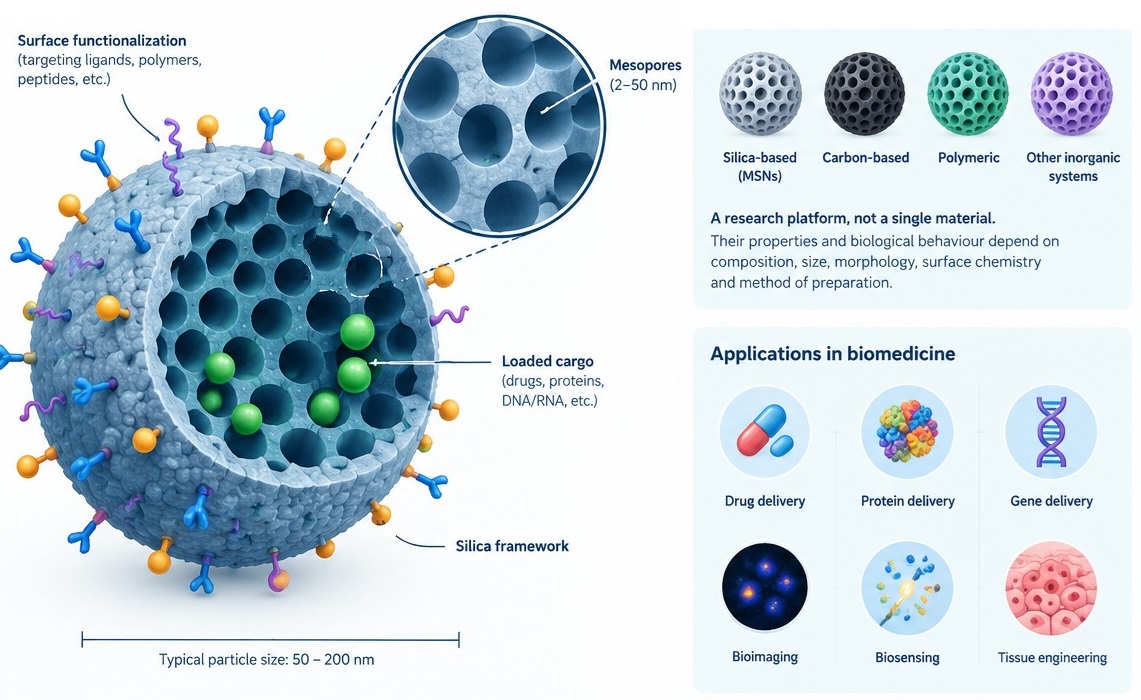
Mesoporous nanoparticles are nanostructured materials containing pores with diameters typically between 2 and 50 nanometres. Their combination of nanoscale dimensions and an internal porous architecture gives them properties that are particularly attractive for biomedical research, including a high specific surface area, substantial pore volume and the possibility of modifying both their internal pores and external surface.
Among the different types of mesoporous nanoparticles, mesoporous silica nanoparticles (MSNs) are among the most extensively investigated for biomedical applications. Their silica framework can be engineered to control particle size, pore size, morphology and surface chemistry. These characteristics have made MSNs promising platforms for the delivery of drugs, proteins and nucleic acids, as well as for bioimaging, biosensing and tissue engineering.
Importantly, mesoporous nanoparticles are a research platform rather than a single material. Depending on their composition and design, they can include silica-based, carbon-based, polymeric and other inorganic mesoporous systems. Their properties and biological behaviour therefore depend strongly on their composition, size, morphology, surface chemistry and method of preparation.
What are mesoporous nanoparticles?
The term mesoporous refers primarily to the size of the pores within a material. According to the conventional classification of porous materials, pores are generally described as:
- Micropores: smaller than 2 nm
- Mesopores: 2–50 nm
- Macropores: larger than 50 nm
Mesoporous nanoparticles combine this porous structure with nanoscale particle dimensions. In the case of MSNs, the particle consists principally of a silica (SiO₂) framework containing an ordered or partially ordered network of mesopores.
The pores can provide internal space for loading molecules, while the outer surface can be chemically modified with functional groups, polymers, peptides, targeting ligands or other components. This separation between the internal cargo-loading space and the external surface is one of the characteristics that makes mesoporous nanoparticles particularly versatile.
The pore size, pore volume, particle size, morphology and surface charge can be adjusted during synthesis. These parameters influence how molecules interact with the nanoparticles, how much cargo can be loaded and how the particles interact with biological systems.
For biomedical applications, mesoporous silica nanoparticles are particularly attractive because silica chemistry allows relatively straightforward surface functionalization. However, the term mesoporous nanoparticles should not be considered synonymous with mesoporous silica nanoparticles: MSNs are one important subgroup within the broader family.
Advantages of mesoporous nanoparticles
Mesoporous nanoparticles offer several characteristics that can be useful when designing biomedical nanomaterials.
High specific surface area
The presence of numerous nanoscale pores can provide a large internal and external surface area relative to the particle’s overall size. This can facilitate the adsorption or loading of therapeutic and diagnostic molecules.
High and tunable loading capacity
The porous architecture provides internal volume that can accommodate a range of molecules. Depending on the material and surface chemistry, mesoporous nanoparticles have been investigated for loading small-molecule drugs as well as larger biological cargoes such as proteins, DNA and RNA.
Controlled and stimuli-responsive release
The release of molecules from mesoporous nanoparticles can be influenced by pore characteristics and surface modifications. Researchers have developed systems designed to respond to conditions such as pH, enzymes, redox conditions, temperature, light or magnetic fields, with the aim of controlling when and where a cargo is released.
Versatile surface functionalization
Silica surfaces can be chemically modified with different functional groups. This enables the incorporation of polymers, targeting molecules, biomolecules and other components designed to modify cellular interactions, colloidal behaviour or cargo release.
Structural tunability
Particle size, morphology, pore diameter and surface properties can be adjusted through changes in synthesis conditions. This tunability allows researchers to design mesoporous nanoparticles for different experimental requirements.
These advantages do not automatically translate into clinical efficacy or safety. Biodistribution, degradation, clearance, biological interactions and toxicity must be evaluated for each specific formulation and application. Current research continues to address these issues and the challenges involved in clinical translation.
How are mesoporous nanoparticles synthesized?
The synthesis method depends on the composition and intended characteristics of the nanoparticles. For mesoporous silica nanoparticles, one of the most widely used approaches is template-directed sol-gel synthesis.
In a typical process, a silica precursor such as tetraethyl orthosilicate (TEOS) is combined with a structure-directing agent, often a surfactant. The surfactant molecules self-assemble into micellar or other organized structures. Silica precursors undergo hydrolysis and condensation around these structures, generating the silica framework. Subsequent removal of the template leaves behind the mesoporous network.
Different synthesis strategies can be used to control the resulting particle characteristics. These include:
- Sol-gel and soft-templating approaches, widely used for MSNs.
- Hard-templating methods, in which a pre-existing structure is used to define the resulting porous architecture.
- Hydrothermal approaches, which can modify particle formation and mesostructure.
- Modified Stöber-type methods and related colloidal synthesis strategies.
- Alternative and more sustainable synthesis approaches, including some biomimetic and green synthesis methods.
Parameters such as precursor concentration, surfactant type and concentration, pH, temperature, reaction time and the ratio between the different components can influence particle size, morphology and pore structure. Consequently, synthesis is an important part of designing a mesoporous nanoparticle for a particular biomedical application.
After synthesis, additional steps may be required to remove the template, purify the nanoparticles and functionalize their surfaces. Surface engineering can subsequently be used to modify properties such as charge, targeting behaviour, colloidal stability or responsiveness to specific biological conditions.
Biomedical applications of mesoporous nanoparticles
The combination of a tunable porous structure, large surface area and modifiable surface chemistry has led to extensive investigation of mesoporous nanoparticles in biomedicine. Key areas include biomolecule and gene delivery, regenerative medicine, diagnostic imaging and drug delivery.
1. Biomolecule delivery and gene therapy
One of the most actively investigated applications of mesoporous nanoparticles is the delivery of biological macromolecules and nucleic acids.
The pores of mesoporous nanoparticles can provide space for loading proteins, peptides, antigens and nucleic acids, while surface functionalization can be used to influence interactions with cells and biological barriers. MSNs have therefore been investigated as carriers for DNA, RNA and other therapeutic biomolecules.
Gene delivery presents particular challenges because nucleic acids are susceptible to degradation and their successful therapeutic use generally requires protection, cellular uptake and appropriate intracellular trafficking. Mesoporous silica nanoparticles can be functionalized with positively charged groups, polymers, peptides or other components to facilitate nucleic-acid association and cellular delivery.
Research has explored MSN-based systems for the delivery of plasmid DNA, small interfering RNA (siRNA), messenger RNA and other nucleic-acid cargos. More recently, mesoporous silica platforms have also been investigated for delivering components associated with CRISPR-based gene editing.
An important research objective is to control the entire delivery process, from protection of the cargo and cellular uptake to intracellular release. Surface engineering and core-shell architectures are among the strategies being investigated to overcome biological barriers and improve delivery efficiency.
It is important to distinguish these research developments from established clinical applications. Although mesoporous nanoparticles have demonstrated considerable potential in experimental gene and biomolecule delivery, further work is required to address issues such as biodistribution, biodegradation, toxicity, immune interactions and efficient delivery in vivo.
2. Regenerative medicine
Mesoporous silica nanoparticles have also been investigated in tissue engineering and regenerative medicine.
Their porous structure and modifiable surface chemistry can enable them to act as carriers for bioactive molecules within biomaterial systems. For example, MSNs can be incorporated into scaffolds or other engineered materials with the objective of providing localized and controlled delivery of biological signals.
In tissue engineering, this approach can be particularly interesting when the spatial and temporal presentation of bioactive molecules is important. Mesoporous nanoparticles can potentially provide a reservoir for molecules that would otherwise diffuse rapidly from a biomaterial.
Research has investigated MSN-containing systems in areas including bone regeneration, tissue engineering and bioactive scaffolds. The nanoparticles can also be combined with other biomaterials to create multifunctional systems whose mechanical, structural and biological properties are tailored to a particular application.
As with other biomedical uses, these approaches remain an active area of research, and factors such as nanoparticle degradation, long-term biological effects and interactions with the surrounding tissue need to be carefully evaluated.
3. Diagnostic imaging
Mesoporous nanoparticles can also serve as components of biomedical imaging and theranostic platforms.
Their porous structure provides space for incorporating imaging-related components, while their surfaces can be functionalized with molecules designed to interact with specific biological targets. MSNs have been investigated in combination with fluorescent materials, magnetic nanoparticles and other imaging agents to develop multifunctional systems.
This approach can enable the combination of imaging and therapeutic functions in a single nanoplatform. Such systems are commonly described as theranostic nanoparticles, particularly when diagnostic information is integrated with therapeutic delivery.
Mesoporous materials have also been investigated in biosensing and in vitro diagnostic applications. Their high surface area and capacity for surface functionalization can be useful for immobilizing recognition molecules and signal-generating components.
4. Drug delivery
Drug delivery remains one of the most extensively studied biomedical applications of mesoporous nanoparticles.
The internal pore network can accommodate therapeutic compounds, including molecules with poor aqueous solubility. Surface modifications and pore-gating strategies can then be used to influence drug release. Research has explored systems designed for immediate, sustained, controlled, targeted and stimuli-responsive drug delivery.
Stimuli-responsive systems are particularly interesting because they are designed to release their cargo in response to specific environmental conditions. Depending on the system, the trigger may be a change in pH, redox state, enzyme activity, temperature, light or another physical or chemical stimulus.
Mesoporous nanoparticles have therefore been investigated for the delivery of a wide variety of therapeutic compounds, including anticancer agents and poorly soluble drugs. However, the development of an effective nanomedicine requires more than high drug loading: stability, pharmacokinetics, biodistribution, toxicity, clearance and reproducible manufacturing must also be considered.
Frequently Asked Questions
What are mesoporous nanoparticles?
Mesoporous nanoparticles are nanoscale particles containing pores generally measuring between 2 and 50 nm in diameter. Their porous structure provides a high surface area and internal volume that can be exploited for molecular loading and other biomedical applications.
What are mesoporous silica nanoparticles?
Mesoporous silica nanoparticles (MSNs) are a type of mesoporous nanoparticle in which the porous framework is primarily composed of silica. They are extensively studied because their particle size, pore structure and surface chemistry can be engineered for different applications.
What can mesoporous nanoparticles be used for?
Research applications include biomolecule and gene delivery, regenerative medicine, drug delivery, diagnostic imaging, biosensing and theranostics.
Can mesoporous nanoparticles deliver DNA and RNA?
Yes. Mesoporous silica nanoparticles have been investigated for the delivery of different nucleic acids, including DNA and RNA. Surface functionalization can help address challenges associated with nucleic-acid loading, cellular uptake and intracellular delivery.
Why are mesoporous nanoparticles useful for drug delivery?
Their internal pores provide space for loading therapeutic compounds, while their surface chemistry can be modified to influence interactions with biological systems and drug release. Some systems can also be engineered to respond to specific environmental stimuli.
Are mesoporous nanoparticles safe?
Safety depends on the specific nanoparticle, including its composition, size, morphology, surface chemistry, dose and route of administration. Although many mesoporous nanoparticle systems have shown promising biocompatibility in experimental studies, biosafety, biodistribution, degradation and long-term biological effects remain important areas of research.
Are mesoporous nanoparticles clinically approved?
Mesoporous nanoparticles are primarily an active research area in nanomedicine. Promising experimental results do not by themselves establish clinical efficacy or regulatory approval, and translation requires extensive evaluation of safety, manufacturing, pharmacology and clinical performance.
Conclusion
The design and characterization of mesoporous nanoparticles often requires expertise spanning nanomaterial synthesis, physicochemical characterization, biomolecule loading, in vitro testing, imaging and preclinical evaluation.
Through its distributed infrastructure, NANBIOSIS provides access to complementary capabilities for the development and characterization of nanomedicine technologies, supporting research projects from material design and characterization through biological evaluation and preclinical research.
Related articles
- …
What is NANBIOSIS?
The goal of NANBIOSIS is to provide comprehensive and integrated advanced solutions for companies and research institutions in biomedical applications. All of this is done through a single-entry point, involving the design and production of biomaterials, nanomaterials, and their nanoconjugates. This includes their characterization from physical-chemical, functional, toxicological, and biological perspectives (preclinical validation).

In order to access our Cutting-Edge Biomedical Solutions with priority access, enter our Competitive Call here.
NANBIOSIS has worked with pharmaceutical companies of all sizes in the areas of drug delivery, biomaterials and regenerative medicine. Here are a few of them: