





Introduction
Gold nanoparticles (AuNPs) are among the most extensively studied inorganic nanomaterials in nanomedicine and biomedical research. Their combination of tunable size and shape, distinctive optical properties, high surface-to-volume ratio and versatile surface chemistry makes them valuable platforms for designing systems for drug and biomolecule delivery, biosensing, imaging and therapeutic applications.
Unlike bulk gold, gold at the nanoscale exhibits physicochemical properties that can be strongly influenced by particle size, morphology, surface chemistry and the surrounding environment. In particular, gold nanoparticles display localized surface plasmon resonance (LSPR), an optical phenomenon that gives rise to strong and size- and shape-dependent interactions with light. This property can be exploited for sensing, imaging and photothermal applications.
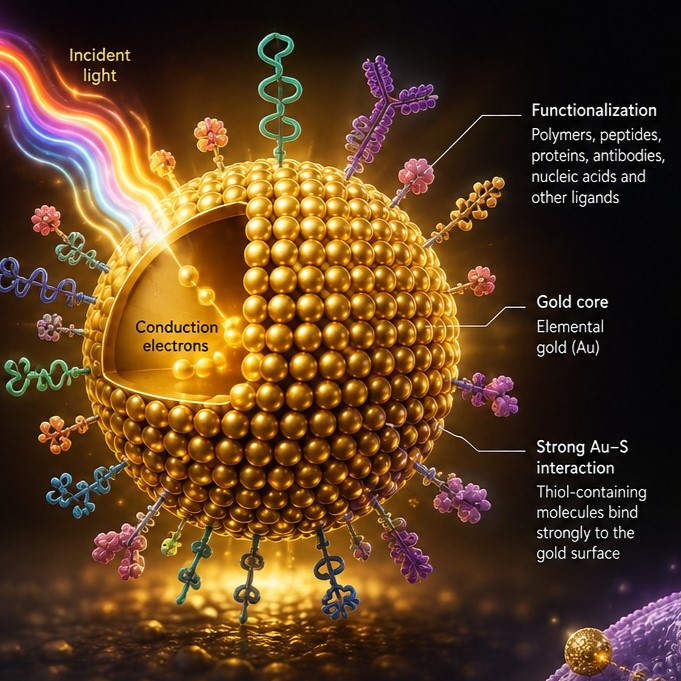
Another important feature is the ability to functionalize the gold surface with a wide variety of molecules, including polymers, peptides, proteins, antibodies and nucleic acids. This makes AuNPs particularly attractive as multifunctional platforms that can combine delivery, targeting, sensing and therapeutic functions within the same nanosystem.
For these reasons, gold nanoparticles continue to attract considerable interest in nanomedicine, drug delivery, gene therapy, regenerative medicine, biosensing and cancer research. However, many proposed biomedical applications remain at the experimental or preclinical stage, and factors such as biodistribution, clearance, long-term safety, surface chemistry and manufacturing reproducibility remain important considerations for clinical translation.
What are Gold Nanoparticles?
Gold nanoparticles are nanoscale structures composed primarily of elemental gold (Au). They can be produced in different sizes and morphologies, including spherical nanoparticles, nanorods, nanoshells, nanostars, nanocages and other anisotropic structures.
Their properties depend strongly on their physical and chemical characteristics. Important parameters include:
- Particle size: influences cellular uptake, biodistribution, optical properties and interactions with biological systems.
- Shape and morphology: determine optical and plasmonic behaviour and can influence biological interactions.
- Surface chemistry: affects colloidal stability, protein adsorption, cellular interactions and biological fate.
- Surface charge: can influence interactions with cell membranes and biomolecules.
- Ligand or coating: polymers, peptides, antibodies, nucleic acids and other molecules can be attached to the gold surface to provide targeting or functional properties.
One of the most characteristic properties of AuNPs is their localized surface plasmon resonance. At the appropriate nanoscale dimensions, incident light can interact with the conduction electrons of the gold nanoparticle, producing strong optical absorption and scattering. The resulting optical response changes with particle size, shape, aggregation state and surrounding medium.
The gold surface can also interact strongly with thiol-containing molecules, providing a widely used route for surface functionalization. Together with other conjugation strategies, this enables the construction of AuNP-based systems carrying therapeutic molecules, targeting ligands or recognition elements.
Advantages of Gold Nanoparticles
The interest in gold nanoparticles for biomedical applications comes from several complementary advantages.
Tunable physicochemical properties
AuNPs can be engineered with different sizes, shapes and surface chemistries. These parameters can be adjusted to modify their optical, colloidal and biological behaviour.
Unique optical properties
Their LSPR gives AuNPs distinctive optical responses. By modifying particle size and morphology, researchers can tune absorption and scattering properties, including responses in regions of the spectrum relevant to biological applications. Gold nanostructures designed to interact with near-infrared light are particularly interesting for photothermal approaches because near-infrared wavelengths can penetrate biological tissues more effectively than visible light.
High surface area and versatile functionalization
The large surface area relative to their volume allows numerous molecules to be associated with an individual nanoparticle. AuNPs can therefore be functionalized with drugs, nucleic acids, peptides, proteins, antibodies, polymers and other ligands.
Multifunctionality
A single AuNP platform can potentially combine several functions, such as biomolecule delivery, molecular recognition, imaging and photothermal activity. This multifunctionality is one of the reasons AuNPs are being investigated for theranostic applications, in which diagnosis and therapy are integrated into a single platform.
Catalytic and enzyme-mimicking properties
Gold nanoparticles can exhibit catalytic activity and, depending on their size, morphology and surface chemistry, can show enzyme-like activities. These materials are often referred to as gold nanozymes. Reported enzyme-mimicking activities include peroxidase-, oxidase-, catalase- and superoxide-dismutase-like behaviour.
At the same time, these advantages should not be interpreted as evidence that all AuNP formulations are inherently safe or clinically suitable. Their biological effects depend substantially on parameters such as size, shape, surface coating, dose, aggregation and exposure route. Understanding these structure–activity relationships is therefore essential for biomedical development.
How are Gold Nanoparticles Synthesized?
Gold nanoparticles can be synthesized using several chemical, physical and biological approaches. The selected method depends on the desired particle size, morphology, surface chemistry, dispersity and intended application.
Chemical synthesis
A widely used approach is the Turkevich method, in which a gold precursor such as chloroauric acid (HAuCl₄) is reduced in the presence of citrate. The process involves the formation of gold nuclei followed by particle growth. Reaction conditions influence nucleation and growth and therefore affect the resulting particle size and distribution.
Other chemical approaches include:
- Seed-mediated growth, which allows controlled growth of nanoparticles from preformed seeds and is particularly useful for producing anisotropic structures such as nanorods.
- Sodium borohydride reduction, which can produce small gold nanoparticles under appropriate reaction conditions.
- Brust–Schiffrin synthesis, commonly used to prepare thiol-protected gold nanoparticles.
- Ascorbic-acid-based reduction methods, used in several controlled-growth approaches.
Biological or “green” synthesis
Biological synthesis uses biological materials or extracts as reducing and/or stabilizing agents. Plant extracts, microorganisms and biomolecules have all been investigated for the production of gold nanoparticles.
These approaches can reduce the use of some conventional chemical reagents, but biological synthesis can also introduce challenges related to batch-to-batch variability, composition and reproducibility. Consequently, the most appropriate synthesis route depends on the requirements of the final biomedical application.
Surface functionalization
Synthesis is only one part of AuNP engineering. For biomedical applications, the nanoparticle surface is frequently modified after synthesis or functionalized during preparation.
Surface coatings can improve colloidal stability and provide functional groups for attaching biological molecules. For example, AuNPs can be functionalized with nucleic acids, peptides, proteins, antibodies or polymers. Such modifications can influence cellular uptake, biodistribution, targeting and the interaction of the nanoparticles with biological fluids.
Biomedical Applications of Gold Nanoparticles
1. Biomolecule Delivery and Gene Therapy
One of the most important research applications of gold nanoparticles is the delivery of biomolecules, including nucleic acids, proteins, peptides and small-molecule therapeutics.
The gold surface provides a versatile scaffold for attaching biological cargo through covalent interactions, chemisorption, electrostatic interactions or linker-based strategies. This enables the development of nanosystems designed to transport therapeutic molecules to specific cells or tissues.
Nucleic acid delivery
AuNPs have been extensively investigated as carriers for DNA, RNA, small interfering RNA (siRNA), microRNA and other nucleic acids. Functionalized gold nanoparticles can protect nucleic acids from degradation and facilitate their transport into cells.
This makes them particularly interesting for research into gene therapy and gene regulation. Depending on their design, AuNP-based systems can be investigated for:
- Gene delivery
- Gene silencing
- RNA interference
- Delivery of therapeutic DNA
- Delivery of RNA-based therapeutics
- Intracellular delivery of biomolecules
However, efficient intracellular delivery remains challenging. Endosomal entrapment, intracellular trafficking, tissue distribution and controlled release are among the factors that must be addressed when developing AuNP-based nucleic acid delivery systems.
Controlled biomolecule release
AuNPs can also be engineered to release their cargo in response to specific stimuli, including changes in pH, enzymatic activity or light. Combining a gold core with an appropriate surface coating or linker can therefore provide a platform for controlled or stimuli-responsive delivery.
This is particularly relevant when the objective is to deliver a therapeutic molecule while limiting its exposure to non-target tissues.
2. Regenerative Medicine
Gold nanoparticles are also being investigated in tissue engineering and regenerative medicine.
In this context, AuNPs can be incorporated into biomaterials, hydrogels and scaffolds or used as components of systems designed to deliver bioactive molecules. Nanoparticle-containing biomaterials can potentially provide spatially controlled presentation of growth factors, genes or other signalling molecules while also modifying the physicochemical properties of the scaffold.
The optical and conductive properties of gold can also be relevant when designing advanced biomaterials for cellular engineering and tissue regeneration.
Potential research areas include:
- Tissue-engineering scaffolds
- Controlled delivery of growth factors
- Wound-healing systems
- Cellular engineering
- Bone and other tissue regeneration
- Multifunctional biomaterials
Importantly, the role of AuNPs in regenerative medicine is highly dependent on their concentration, size, surface chemistry and biological environment. Consequently, their effects on cell viability, differentiation and tissue responses need to be evaluated for each formulation rather than assumed from the properties of bulk gold.
3. Sensors and Biosensors
Gold nanoparticles are particularly attractive for biosensing because their optical properties change in response to changes in their local environment.
One important mechanism is plasmonic coupling. When functionalized AuNPs interact with target molecules and their spatial arrangement changes, measurable changes in optical properties can occur. This principle has been exploited in research on sensors for nucleic acids, proteins, pathogens and other biological targets.
AuNPs can also be incorporated into electrochemical and surface-enhanced Raman scattering (SERS) platforms, providing additional routes for sensitive molecular detection.
Their surface can be functionalized with antibodies, aptamers, oligonucleotides or other recognition elements, allowing the design of selective biosensors.
4. Diagnostic Imaging
Gold nanoparticles are being investigated as contrast and imaging agents because of their strong interaction with light and X-rays.
Depending on their structure and functionalization, AuNPs can contribute to optical imaging, photoacoustic imaging and X-ray-based imaging approaches. Gold nanostructures can also be functionalized with targeting molecules to investigate selective accumulation or molecular recognition.
Gold nanoclusters represent a related class of gold nanomaterials with different optical properties. In particular, some gold nanoclusters exhibit fluorescence and have been investigated for bioimaging and molecular detection.
5. Nanomedicine and Cancer Therapy
The combination of delivery, optical and surface-engineering capabilities makes AuNPs an important platform in nanomedicine.
One extensively investigated approach is photothermal therapy. Gold nanostructures can absorb light and convert part of the absorbed energy into heat. When appropriately designed and localized, this photothermal effect can be used to investigate localized thermal damage to tumour cells.
Gold nanoparticles have also been explored as carriers for anticancer drugs and as components of multifunctional systems combining therapy and imaging.
These approaches are promising, but their clinical translation depends on overcoming challenges including tumour delivery, nanoparticle clearance, toxicity, manufacturing and reproducibility. Therefore, many AuNP-based cancer therapies remain under investigation rather than constituting routine clinical treatments.
6. Catalysis in the Tumour Microenvironment
A particularly active research area is the use of nanoparticle catalysis to manipulate the tumour microenvironment (TME).
Tumours can exhibit distinctive characteristics such as altered pH, hypoxia and abnormal levels of reactive oxygen species. Researchers are investigating whether catalytic nanomaterials can exploit these characteristics to generate or remove reactive species and modify biochemical processes within tumours.
Gold nanoparticles and gold-containing nanomaterials can contribute catalytic activity to multifunctional nanosystems. In broader nanozyme research, catalytic nanomaterials have been investigated for tumour-responsive reactions, reactive oxygen species generation and modulation of the tumour microenvironment.
This area remains predominantly experimental. Designing catalytic systems that are sufficiently selective, active under physiological conditions and safely delivered to tumour tissue remains a major challenge.
7. Artificial Enzymes and Gold Nanozymes
Gold nanoparticles can exhibit enzyme-like catalytic activity, leading to their investigation as artificial enzymes or nanozymes.
Depending on their physicochemical characteristics, AuNPs have been reported to show activities resembling several natural enzymes, including:
- Peroxidase
- Oxidase
- Catalase
- Superoxide dismutase
- Reductase
Their catalytic behaviour can depend strongly on particle size, morphology, surface chemistry, pH, temperature and the molecules surrounding the nanoparticle.
This provides opportunities for applications in biosensing, diagnostics and therapeutic research. For example, nanozyme activity can be coupled to a biochemical recognition event to amplify a detectable signal.
In cancer research, nanozymes are also being investigated as catalytic components capable of interacting with the tumour microenvironment and regulating reactive oxygen species.
However, gold nanozymes should not be considered direct replacements for natural enzymes in all circumstances. Their catalytic activity and selectivity are strongly dependent on the specific nanoparticle design and experimental conditions, and further work is required to establish robust biomedical applications.
Frequently Asked Questions
What are gold nanoparticles?
Gold nanoparticles (AuNPs) are nanoscale structures made primarily of elemental gold. Their properties differ from bulk gold and can be tuned through particle size, shape, surface chemistry and functionalization.
Why are gold nanoparticles useful in biomedicine?
AuNPs combine distinctive optical properties, a large functionalizable surface and tunable physicochemical characteristics. These features make them useful research platforms for biomolecule delivery, biosensing, imaging, regenerative medicine and therapeutic applications.
Can gold nanoparticles be used for gene delivery?
Yes. Gold nanoparticles have been extensively investigated as carriers for DNA, RNA, siRNA and other nucleic acids. Their surfaces can be functionalized with nucleic acids and targeting or delivery components. However, efficient intracellular delivery and safe in vivo performance remain important challenges.
How are gold nanoparticles synthesized?
Common approaches include citrate reduction using the Turkevich method, seed-mediated growth, sodium-borohydride reduction, Brust–Schiffrin synthesis, ascorbic-acid-based methods and biological or “green” synthesis. The appropriate method depends on the required size, shape, dispersity and surface chemistry.
What is localized surface plasmon resonance?
Localized surface plasmon resonance is an optical phenomenon associated with the collective oscillation of conduction electrons in metallic nanoparticles. In AuNPs, it produces strong and tunable optical responses that can be exploited for sensing, imaging and photothermal applications.
Can gold nanoparticles be used in cancer treatment?
Gold nanoparticles are being investigated in several cancer-related applications, including drug delivery, photothermal therapy, imaging and catalytic or nanozyme-based approaches. Many of these applications remain in preclinical research, and their clinical translation depends on factors such as targeting, safety, biodistribution and manufacturing.
What are gold nanozymes?
Gold nanozymes are gold-based nanomaterials that exhibit enzyme-like catalytic activities. Depending on their design, they can show peroxidase-, oxidase-, catalase- or other enzyme-mimicking activities.
Are gold nanoparticles safe?
Safety cannot be determined solely from the fact that a nanoparticle is made of gold. Biological responses depend on factors such as particle size, shape, surface chemistry, dose, aggregation and exposure route. Detailed physicochemical and biological characterization is therefore essential when developing AuNPs for biomedical applications.
Conclusion
Gold nanoparticles are versatile nanomaterials with a distinctive combination of optical, physicochemical and surface-chemical properties. Their tunable size and morphology, strong plasmonic behaviour and capacity for functionalization make them valuable platforms for biomedical research.
Among their most promising applications are biomolecule and nucleic-acid delivery, gene therapy research, regenerative medicine, biosensing and diagnostic imaging. Their ability to convert light into heat has also made gold nanostructures important candidates for photothermal cancer research, while their catalytic properties have opened additional research directions in tumour-microenvironment modulation and nanozyme-based systems.
Nevertheless, translating these technologies from laboratory research to clinical applications requires careful control of nanoparticle size, morphology, surface chemistry, stability, biodistribution and toxicity. Reliable characterization and reproducible manufacturing are therefore fundamental to the development of effective gold nanoparticle-based biomedical systems.
For researchers developing gold nanoparticle-based drug delivery systems, gene delivery platforms, biosensors, regenerative biomaterials or other nanomedicine technologies, access to advanced nanomaterial production and characterization capabilities can be an important part of the development pathway.
Related articles
- ...
What is NANBIOSIS?
The goal of NANBIOSIS is to provide comprehensive and integrated advanced solutions for companies and research institutions in biomedical applications. All of this is done through a single-entry point, involving the design and production of biomaterials, nanomaterials, and their nanoconjugates. This includes their characterization from physical-chemical, functional, toxicological, and biological perspectives (preclinical validation).
In order to access our Cutting-Edge Biomedical Solutions with priority access, enter our Competitive Call here.
NANBIOSIS has worked with pharmaceutical companies of all sizes in the areas of drug delivery, biomaterials and regenerative medicine. Here are a few of them: