





Introduction
Lipid nanoparticles (LNPs) have become one of the most important nanomedicine platforms for the delivery of therapeutic molecules. Their ability to encapsulate and protect sensitive biological cargo, facilitate cellular uptake and, in appropriately designed formulations, promote intracellular release has made them particularly valuable for delivering nucleic acids such as messenger RNA (mRNA) and small interfering RNA (siRNA).
The clinical success of lipid nanoparticle-based medicines has demonstrated the potential of nanotechnology to overcome some of the limitations associated with conventional drug delivery. A major milestone was the development of LNP formulations for RNA therapeutics, including the siRNA medicine patisiran and LNP-formulated mRNA COVID-19 vaccines. These applications have also accelerated research into LNPs for gene editing, cancer treatment, protein replacement, vaccination, imaging and other biomedical applications.
At the same time, LNP technology continues to evolve. Researchers are developing new lipid chemistries, manufacturing strategies and targeting approaches to improve tissue specificity, stability, safety and therapeutic efficacy.
What are Lipid Nanoparticles?
Lipid nanoparticles are nanoscale delivery systems composed primarily of lipids that self-assemble into particles capable of carrying therapeutic or diagnostic molecules.
Although the terms are sometimes used interchangeably, lipid nanoparticles and liposomes are not the same technology. Liposomes generally contain an aqueous compartment enclosed by one or more lipid bilayers, whereas many modern LNP formulations used for nucleic acid delivery have more complex, formulation-dependent internal structures that differ from the classical bilayer organization of liposomes.
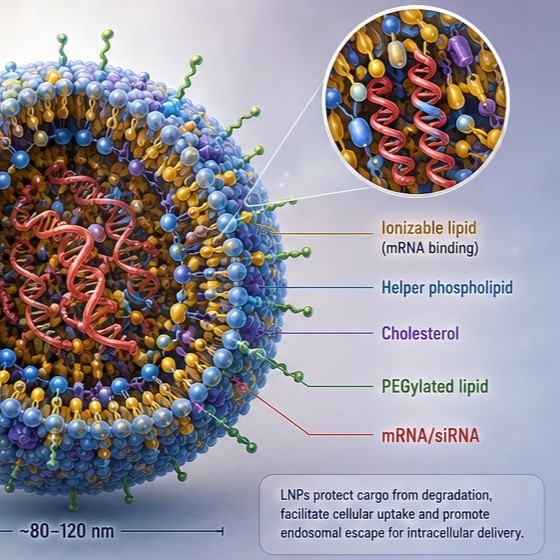
A widely used LNP architecture contains four main types of components:
- Ionizable lipids, which interact with negatively charged nucleic acids and play a key role in particle formation, cellular uptake and endosomal escape.
- Helper phospholipids, which contribute to particle structure and stability.
- Cholesterol, which influences particle organization and membrane interactions.
- PEGylated lipids, which can help control particle size, aggregation and stability.
The exact composition varies depending on the intended application. The choice of lipid chemistry and formulation parameters can strongly influence particle size, encapsulation efficiency, biodistribution, cellular uptake, endosomal escape and biological activity.
For nucleic acid delivery, LNPs are particularly useful because they can protect RNA from degradation in biological environments and facilitate its transport into cells. Following cellular uptake, successful formulations need to escape the endosomal compartment so that the cargo can reach its intracellular site of action.
Advantages of Lipid Nanoparticles
LNPs offer several properties that make them attractive for biomedical research and pharmaceutical development.
Protection of sensitive biomolecules
RNA and other biological molecules can be vulnerable to enzymatic degradation. Encapsulation within an LNP can protect the cargo during formulation, administration and transport through biological environments.
Facilitated intracellular delivery
LNPs can facilitate cellular uptake through endocytic pathways. For RNA therapeutics, the ability of appropriately designed ionizable lipids to promote endosomal escape is particularly important for achieving intracellular delivery.
Versatile cargo loading
LNPs can be engineered to carry different types of therapeutic cargo, including mRNA, siRNA and other nucleic acids. They can also be investigated for the delivery of proteins, small-molecule drugs and combinations of therapeutic agents.
Tunable physicochemical properties
Particle size, lipid composition, surface characteristics, cargo-to-lipid ratio and other formulation parameters can be modified to influence biological behaviour. This tunability provides opportunities to adapt LNPs to different therapeutic objectives.
Established clinical translation for nucleic-acid delivery
Unlike many nanomedicine platforms that remain primarily at the preclinical stage, LNP technology has already demonstrated clinical utility for nucleic-acid delivery. Patisiran uses an LNP formulation to deliver siRNA to the liver, while LNPs are also used to deliver mRNA in COVID-19 vaccines.
Potential for scalable manufacturing
Modern LNP production frequently uses controlled rapid mixing processes, including microfluidic and related mixing technologies. These approaches can provide reproducible particle formation and offer potential pathways for scalable manufacturing.
However, LNPs are not universally optimal for every application. Challenges include tissue-specific targeting, stability, manufacturing consistency, immune responses and potential toxicity associated with particular lipid compositions. Current research therefore focuses on developing increasingly selective and biocompatible formulations.
How are Lipid Nanoparticles Synthesized?
The preparation of LNPs depends on their composition and intended application. For nucleic acid-loaded LNPs, one of the most widely used approaches is rapid mixing of a lipid-containing organic phase with an aqueous phase containing the nucleic acid.
Typically, the lipids are dissolved in an organic solvent, commonly ethanol, while the nucleic acid is prepared in an aqueous buffer under appropriate pH conditions. When the two streams are rapidly mixed, changes in solvent composition and lipid ionization promote lipid self-assembly and nanoparticle formation. The nucleic acid becomes associated with or encapsulated within the developing particles.
Microfluidic mixing
Microfluidic systems can provide highly controlled mixing conditions and are particularly attractive for LNP formulation development. Parameters such as flow rates, mixing conditions, lipid concentration and aqueous-to-organic phase ratios can affect particle size, polydispersity and encapsulation efficiency.
Following particle formation, additional processing steps may be required. These can include removal or reduction of organic solvent, buffer exchange, concentration and sterile filtration, depending on the formulation and intended application.
Characterization
A comprehensive characterization strategy is essential to determine whether an LNP formulation has the required properties. Common parameters include:
- Particle size and size distribution
- Polydispersity
- Surface characteristics
- Encapsulation efficiency
- Lipid composition and purity
- Cargo integrity
- Stability during storage
- In vitro cellular uptake and biological activity
- In vivo biodistribution and pharmacokinetics, when appropriate
For therapeutic development, formulation characterization must ultimately be connected to critical quality attributes and biological performance.
Biomedical Applications of Lipid Nanoparticles
LNPs are being investigated across a broad range of biomedical applications. Some applications, particularly nucleic acid delivery, have already reached clinical use, whereas others remain at the research or preclinical development stage.
1. Biomolecule Delivery and RNA Therapeutics
One of the most important applications of LNPs is the delivery of biomolecules and nucleic acids.
Nucleic acids such as mRNA and siRNA offer powerful therapeutic possibilities but face important delivery challenges. They are relatively large, hydrophilic and susceptible to degradation, making it difficult for them to cross cellular membranes efficiently.
LNPs can address several of these barriers by encapsulating the nucleic acid, protecting it from degradation and promoting cellular uptake. Once inside the cell, the objective is to release the cargo from the endosomal compartment so that it can exert its biological function.
mRNA delivery
LNPs have become particularly important for mRNA delivery. Once delivered to the cytoplasm, mRNA can be translated by the cell into the encoded protein without needing to enter the nucleus or integrate into the genome.
This approach has been used clinically in mRNA vaccines and is being investigated for applications including:
- Infectious disease vaccination
- Cancer immunotherapy
- Protein replacement
- Genetic and metabolic disorders
- Regenerative medicine
- Genome-editing approaches
The success of LNP-mRNA vaccines demonstrated that this delivery strategy can be translated from laboratory research into large-scale clinical applications.
siRNA delivery and gene silencing
LNPs can also deliver small interfering RNA (siRNA). siRNA can trigger sequence-specific degradation of complementary messenger RNA, reducing the production of a target protein.
A prominent clinical example is patisiran, an LNP-based siRNA therapy that targets transthyretin (TTR) mRNA in the liver. Its development provided important proof of concept for LNP-mediated RNA interference in patients.
Genome editing
LNPs are also being explored as delivery systems for genome-editing technologies, including CRISPR-based systems. In these approaches, LNPs can potentially deliver combinations of nucleic acids encoding or constituting components required for genome editing.
Most LNP-based in vivo genome-editing applications remain investigational, with major challenges around tissue targeting, delivery efficiency, safety and control of editing activity.
2. Imaging and Biodistribution
LNPs can also be investigated as nanocarriers for imaging agents.
By incorporating or associating imaging probes with lipid nanoparticles, researchers can study the biodistribution, cellular uptake and biological behaviour of nanoparticles in vivo. Imaging can therefore be useful not only for diagnosis but also for understanding how a formulation behaves after administration.
For example, imaging techniques can help evaluate the pharmacokinetics and biodistribution of RNA-loaded LNPs during preclinical development. This information can be valuable when optimizing formulations and identifying strategies for improving tissue targeting.
LNPs may also be designed as multifunctional platforms combining diagnostic and therapeutic functions, an approach often referred to as theranostics. However, these applications remain under investigation rather than being established clinical technologies.
3. Regenerative Medicine
LNPs are increasingly being investigated in regenerative medicine, particularly as delivery systems for nucleic acids that can modulate cellular behaviour.
mRNA-loaded LNPs, for example, can transiently provide cells with instructions to produce specific proteins. This creates opportunities to investigate protein expression involved in tissue repair, cell differentiation, angiogenesis and other regenerative processes.
Potential applications include tissue engineering, wound healing, cardiovascular regeneration and the development of strategies for directing cell fate.
Importantly, much of this work remains preclinical. The ability to control where and when therapeutic mRNA is expressed remains one of the major challenges for translating these approaches into regenerative medicine.
4. Controlled Drug Release
LNPs can be engineered to act as controlled drug delivery systems, potentially modifying the pharmacokinetics of therapeutic compounds and influencing where and when cargo becomes available.
Lipid composition, particle structure, cargo properties and environmental conditions can affect release behaviour.
This approach is being investigated for the delivery of small-molecule drugs as well as biological therapeutics. By modifying the formulation, researchers can aim to improve drug solubility, protect sensitive compounds and alter their distribution within the body.
The precise release profile, however, depends strongly on the specific LNP formulation and cargo, meaning that controlled release should be considered a design objective rather than an inherent property of every LNP.
5. Targeted Therapies
One of the major objectives in LNP research is the development of targeted drug delivery systems.
Many conventional LNP formulations exhibit substantial uptake by the liver and by cells of the mononuclear phagocyte system. Consequently, researchers are developing new lipid structures, surface modifications, ligands and formulation strategies to improve delivery to specific organs, tissues or cell populations.
Active targeting strategies may involve incorporating molecules capable of interacting with receptors expressed by particular cell types. Other approaches seek to exploit differences in physiology, biodistribution or protein adsorption to influence where nanoparticles accumulate.
Improving tissue-specific delivery is particularly important for applications such as cancer therapy, neurological disorders and gene editing, where delivery to the appropriate target cells can determine therapeutic success. However, achieving reliable tissue- and cell-specific delivery in vivo remains a major challenge, particularly outside organs such as the liver where many LNP formulations naturally accumulate.
Frequently Asked Questions
What are lipid nanoparticles used for?
Lipid nanoparticles are used to deliver therapeutic and biological molecules, particularly nucleic acids such as mRNA and siRNA. They are also being investigated for drug delivery, vaccines, gene editing, imaging, regenerative medicine and targeted therapies.
Are lipid nanoparticles the same as liposomes?
No. Although both are lipid-based nanocarriers, their structures and compositions differ. Liposomes generally contain an aqueous compartment surrounded by lipid bilayers, whereas many modern LNPs used for nucleic acid delivery have more complex, formulation-dependent internal structures and are specifically engineered for efficient nucleic acid encapsulation and intracellular delivery.
What are lipid nanoparticles made of?
Many nucleic acid LNPs contain an ionizable lipid, a helper phospholipid, cholesterol and a PEGylated lipid. However, the composition varies between formulations and applications.
How do lipid nanoparticles deliver mRNA?
LNPs protect mRNA and facilitate its uptake by cells. Following cellular internalization, the formulation must promote endosomal escape so that the mRNA can reach the cytoplasm, where it can be translated into protein.
Have lipid nanoparticle-based medicines been clinically approved?
Yes. LNP technology has reached clinical use. Patisiran is an LNP-based siRNA medicine, while LNPs are also used to deliver mRNA in COVID-19 vaccines. These applications have provided important clinical validation of LNP-based nucleic acid delivery.
Can lipid nanoparticles be targeted to specific tissues?
Potentially, yes. Researchers are developing lipid chemistries, surface modifications and other formulation strategies to improve tissue and cell targeting. However, achieving reliable delivery to specific tissues remains a major challenge, particularly for extrahepatic tissues where many LNP formulations do not naturally accumulate efficiently.
Are lipid nanoparticles safe?
Safety depends on the specific formulation, cargo, dose, administration route and intended application. LNPs have demonstrated clinical utility, but their lipid components and biodistribution can influence immune responses and other biological effects. Consequently, safety and tolerability must be evaluated for each formulation rather than assumed from the performance of another LNP.
Conclusion
Lipid nanoparticles have evolved from an experimental nanomedicine technology into a clinically validated platform for certain types of nucleic-acid delivery. Their clinical use in siRNA medicines and mRNA vaccines demonstrates the potential of engineered lipid systems to overcome important biological barriers to therapeutic delivery.
At the same time, the field is moving beyond these established applications. Researchers are developing LNPs for gene editing, protein replacement, cancer immunotherapy, targeted drug delivery, diagnostic imaging and regenerative medicine. New lipid chemistries and manufacturing technologies are also being developed to improve tissue specificity, intracellular delivery, stability and safety.
For biomedical research and pharmaceutical development, the ability to tailor LNP composition and physicochemical properties provides a versatile platform for designing advanced delivery systems. Continued progress in formulation, characterization, biological validation and manufacturing will be essential for expanding LNP applications beyond their current clinical uses.
Related articles
- ...
What is NANBIOSIS?
The goal of NANBIOSIS is to provide comprehensive and integrated advanced solutions for companies and research institutions in biomedical applications. All of this is done through a single-entry point, involving the design and production of biomaterials, nanomaterials, and their nanoconjugates. This includes their characterization from physical-chemical, functional, toxicological, and biological perspectives (preclinical validation).

In order to access our Cutting-Edge Biomedical Solutions with priority access, enter our Competitive Call here.
NANBIOSIS has worked with pharmaceutical companies of all sizes in the areas of drug delivery, biomaterials and regenerative medicine. Here are a few of them: