




CIBERBBN and CIBERINFEC held their first joint scientific meeting in Sevilla, highlighting advances in bioengineering, infectious diseases and NANBIOSIS capabilities.
Sevilla, November 2025 — The I Scientific Days CIBERBBN–INFEC was held on 13–14 November 2025 at the Eurostars Al-Andalus Palace Hotel in Sevilla, bringing together leading experts in bioengineering, biomaterials, nanomedicine, and infectious diseases. The two-day joint event, organised by CIBER-BBN and CIBER-INFEC, served as a major forum to strengthen scientific collaboration, foster translational research, and highlight new technologies shaping the future of healthcare.
Throughout the conference, researchers presented advances in biomedical engineering, emerging infections, antimicrobial resistance, global health approaches, and patient engagement. The programme combined plenary lectures, scientific sessions, technology transfer presentations, and networking opportunities. As a key national infrastructure of CIBER-BBN, ICTS NANBIOSIS was prominently featured during the event.
Day 1 Highlights – 13 November
The meeting opened with internal sessions for Principal Investigators from both networks.
M. Pilar Marco, Scientific Director of CIBER-BBN, then welcomed the attendees.
Plenary Lecture: Innovation and health systems
The first plenary session, delivered by Laura Sampietro-Colom (Hospital Clínic Barcelona) and chaired by M. Pau Ginebra, explored the role of early health technology assessment in determining the value of biomedical innovation.
ARISTOS fellows presentations (CIBER-BBN)
Promising early-career researchers presented their ARISTOS projects:
- NanoGlue – Nanoparticles to enhance immune–tumour communication (Erika Pineda)
- BRUHealth – ECGi and modelling for Brugada Syndrome risk stratification (Sofia Romagnoli)
- Next-generation Living Organoids for clinical and screening applications (Lilianne Beola)
- OLEO-CardioSafe – Stem cell-based prevention of chemotherapy-induced cardiotoxicity (Salim Çerig)
“Valorización” Projects (CIBER-BBN)
Three innovation-focused projects showcased their progress:
- BBB-Neuron-a-chip – Brain-on-chip model for drug testing (Mónica Mir)
- Radical-NEED – Metal-free radical dendrimers for MRI in glioblastoma (Vega Lloveras)
- TUMORDIVE – Nanomotors to improve drug penetration in tumours (Alba García)
“Seed” Projects with CIBERESP
Inter-network collaborative initiatives within the CIBER ecosystem included:
- MANEHD – Aptamer-based HIV early diagnostics (César Fernández)
- ALEVINT – Integrative platform for nutrition and translational research (Antonio Cobo)
Opening and presentations of the CIBER areas
Institutional representatives from ISCIII (Marta Ortiz), CIBERINFEC (Jesús Oteo), and CIBERBBN (M. Pilar Marco) officially opened the conference. This was followed by a presentation of both the CIBERBBN and CIBERINFEC areas, by their Scientific Directors: M. Pilar Marco and Jesús Oteo respectivelly.
Plenary Lecture: Swiss Cohorts
Manuel Josep Oriol (Hospital Universitario de Lausana) presented the second plenary session on the value of Swiss population cohorts for clinical and translational infectious disease research.
Scientific Programmes and NANBIOSIS Presentation
The afternoon continued with joint programme presentations across bioengineering, biomaterials, nanomedicine, global health, emerging infections, antimicrobial resistance, HIV/STIs, and infections in immunocompromised patients.
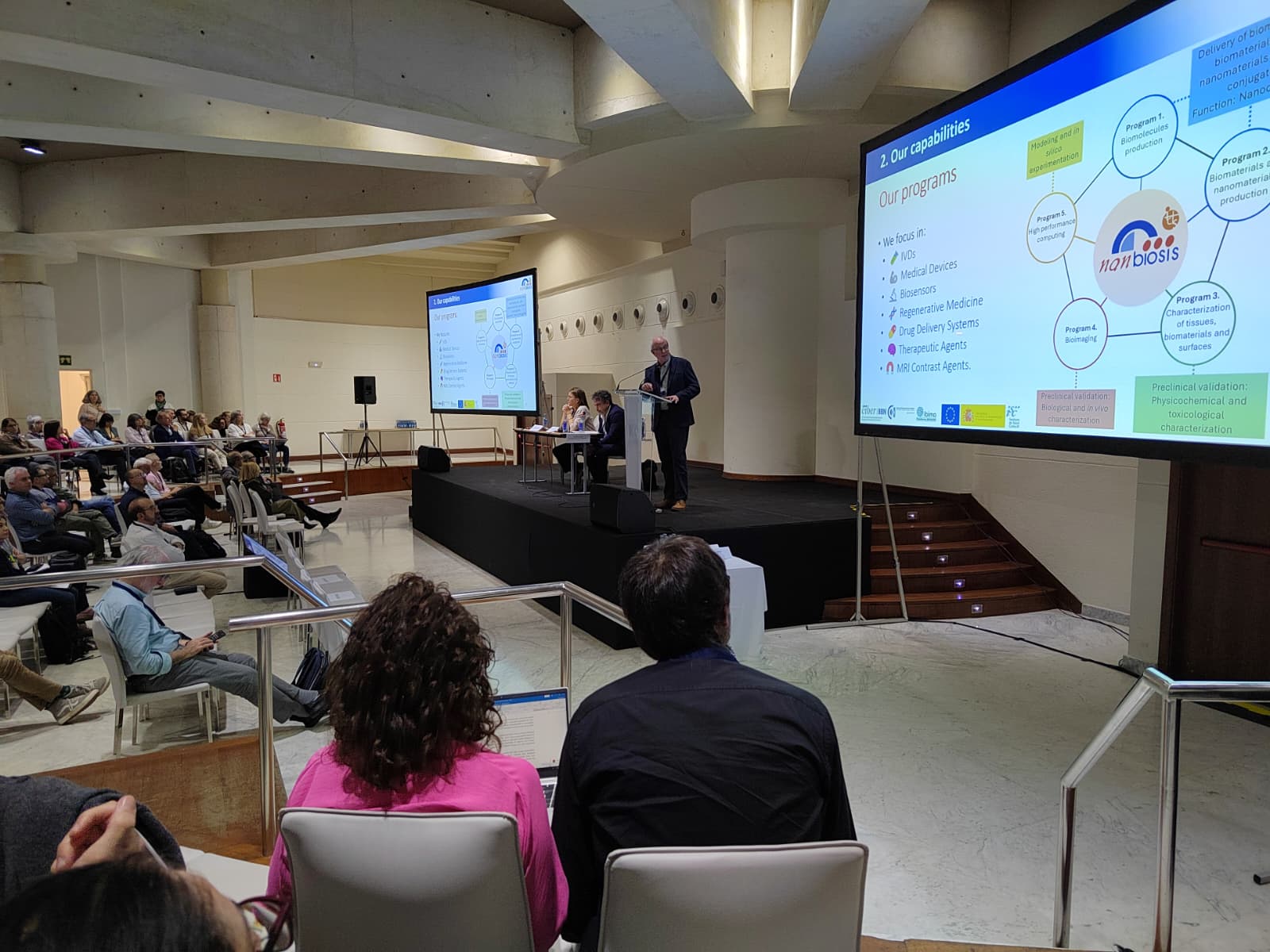
During this session, Ramón Martínez-Máñez, Scientific Director of NANBIOSIS, delivered a dedicated presentation showcasing the technological capabilities, services and integrated platforms of the ICTS. He highlighted how NANBIOSIS supports advanced research in diagnostics, nanomedicine, biomaterials, medical devices, and preclinical studies, reinforcing its strategic value for both CIBER networks.
The day closed with a networking session, encouraging new collaborations between BBN and INFEC teams, in which NANBIOSIS establised invaluable contacts.
Day 2 Highlights – 14 November
Plenary Session with Till Bachmann
The second day began with a plenary lecture by Till Bachmann (University of Edinburgh), chaired by M. Pilar Marco, on rapid diagnostics for AMR.
“Seed” Projects with CIBERINFEC (2024 Call)
Researchers presented two collaborative infectious-disease projects:
- DEMOSTRAR – Nanogels modulating innate immune responses in cytomegalovirus infection (Cristina García de la Mària)
- SAFEGUARD – Antimicrobial functionalisation of cardiac implantable devices (Inma Ratera)
Invited Lecture: Global Health Research
Mireia Coscolla (CSIC) delivered the invited talk “A 360º approach to research in global health,” emphasising genomics, pathogen surveillance, and epidemiological modelling.
Patient Associations
A dedicated session highlighted patient involvement in research, including:
- The CIBER Citizen Participation Plan (Jesús Oteo)
- CESIDA, the national HIV/AIDS coordination network (Jesús Cisneros)
The talks were followed by a group discussion on integrating patient perspectives into biomedical innovation.
CIBER-BBN Intramural Collaborations
CIBER-BBN researchers presented collaborative projects in biomedical engineering and nanomedicine:
- SIP-EP – Signal and image processing tools for arrhythmia management
- HYDROLIVER – Hydrogels for 3D hepatic disease models
- NANOREMOTE – Remote delivery of antitumour proteins
- NANO4INFECTION – Nanoantibiotics for bone infection
- PATHERNO – Point-of-care optics for personalised antibiotic therapy in nosocomial infections
Early Stage Plus Projects (CIBER-BBN)
The final scientific session highlighted innovative early-stage projects:
- ABNANO – Dual-targeted nanomedicine for Alzheimer’s disease
- QUANT-TAU-PET – Quantification tools for new tau PET imaging in a rare neurological disease
- Tattoo4Sleep – Skin tattoo electrodes for sleep monitoring
A networking lunch brought the meeting to a close, strengthening collaboration between CIBERBBN, CIBERINFEC, and the wider scientific community.

What is NANBIOSIS?
The goal of NANBIOSIS is to provide comprehensive and integrated advanced solutions for companies and research institutions in biomedical applications. All of this is done through a single-entry point, involving the design and production of biomaterials, nanomaterials, and their nanoconjugates. This includes their characterization from physical-chemical, functional, toxicological, and biological perspectives (preclinical validation).
In order to access our Cutting-Edge Biomedical Solutions with priority access, enter our Competitive Call here.
NANBIOSIS has worked with pharmaceutical companies of all sizes in the areas of drug delivery, biomaterials and regenerative medicine. Here are a few of them: