





Introduction
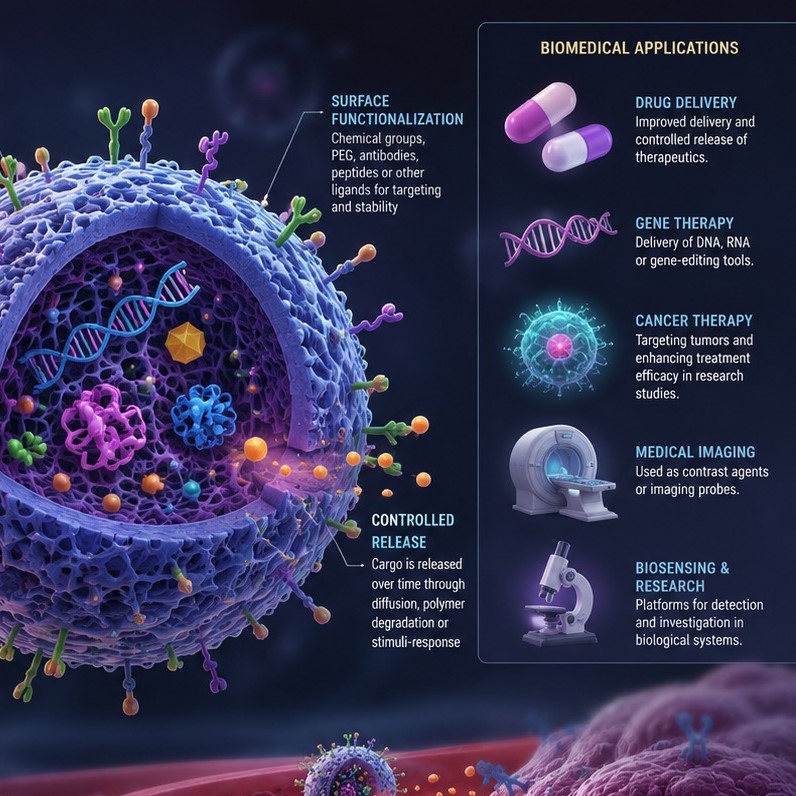
Polymeric nanoparticles are among the most versatile platforms being investigated in nanomedicine. Their ability to encapsulate, protect and transport different types of therapeutic or diagnostic cargo makes them attractive for applications ranging from drug delivery and gene therapy to medical imaging, cancer research and biosensing.
Unlike many conventional drug-delivery systems, polymeric nanoparticles can be engineered by modifying their polymer composition, size, surface properties and internal structure. This allows researchers to tailor their behaviour to a particular biological application, including controlling how a nanoparticle interacts with cells, how long it remains in circulation and how its cargo is released.
The field has advanced considerably through the development of biodegradable polymers, surface functionalization strategies and stimuli-responsive materials. However, most polymeric nanoparticle technologies remain at the research or development stage, and important challenges related to safety, biodistribution, reproducibility, manufacturing and clinical translation still need to be addressed.
What are polymeric nanoparticles?
Polymeric nanoparticles (PNPs) are nanoscale particles formed from polymeric materials. In biomedical research, they are generally designed as carriers or functional nanomaterials whose physicochemical properties can be controlled through the choice of polymer, formulation and surface chemistry.
Depending on their composition and preparation method, polymeric nanoparticles can contain a therapeutic or diagnostic molecule within the particle, associated with the polymer matrix or attached to its surface. Both natural and synthetic polymers have been investigated for these applications.
Examples of polymers used in polymeric nanoparticle systems include poly(lactic-co-glycolic acid) (PLGA), poly(lactic acid (PLA), polycaprolactone (PCL), chitosan and various functional synthetic polymers. PLGA is particularly widely studied because it is biodegradable and has a long history of investigation in biomedical applications.
The physicochemical characteristics of a polymeric nanoparticle—including particle size, size distribution, morphology, surface charge, polymer composition and surface functionalization—can strongly influence its biological behaviour. These parameters can affect colloidal stability, cellular uptake, biodistribution and cargo release.
Importantly, polymeric nanoparticles are not a single type of nanomaterial. Different architectures and formulations can be designed for different purposes, making them a broad platform rather than one standardized technology.
Advantages of polymeric nanoparticles
One of the main advantages of polymeric nanoparticles is their design flexibility. Polymer chemistry allows researchers to modify the structure and properties of the particles according to the intended application.
Controlled and sustained release
Polymeric matrices can be designed to control the release of an encapsulated compound. Depending on the polymer and formulation, release can occur through mechanisms such as diffusion, polymer degradation or changes in the surrounding environment.
This can potentially provide a more controlled exposure to a therapeutic compound than conventional formulations.
Protection of sensitive biomolecules
Nanoparticles can help protect certain biological molecules from degradation before they reach their intended site of action. This is particularly relevant for proteins, peptides and nucleic acids, which can be vulnerable to enzymatic degradation or other biological barriers.
Tunable surface properties
The surface of polymeric nanoparticles can be modified with different chemical groups or biomolecules. Such functionalization can alter interactions with biological systems and, in experimental systems, can be used to investigate strategies for targeting particular cells or tissues.
Versatility in cargo
Polymeric nanoparticles have been investigated for the delivery of a wide variety of molecules, including small-molecule drugs, proteins, peptides, DNA, RNA and other biomolecules.
Biodegradability
Some polymers used in biomedical nanoparticles are biodegradable. For example, PLGA can undergo hydrolytic degradation into lactic acid and glycolic acid, which are subsequently metabolized by the body. However, biodegradability and biocompatibility depend on the specific material, formulation and application and should not be assumed for every polymeric nanoparticle.
How are polymeric nanoparticles synthesized?
The synthesis of polymeric nanoparticles involves producing particles with controlled size, composition and surface characteristics while incorporating the desired cargo.
Several approaches are used, and the appropriate method depends on the polymer, cargo and intended application.
Nanoprecipitation
Nanoprecipitation, also known as solvent displacement, is a widely used approach. A polymer is dissolved in a suitable organic solvent and introduced into a second phase, commonly under controlled mixing conditions. Changes in solvent conditions promote polymer aggregation and nanoparticle formation.
The method can be relatively straightforward and is particularly useful for incorporating hydrophobic compounds.
Emulsification and solvent evaporation
In emulsion-based methods, a polymer solution and another immiscible phase are combined to form droplets. The solvent is subsequently removed, leaving polymeric nanoparticles.
Different configurations, including single and double emulsions, can be used depending on the properties of the cargo. Double-emulsion methods are particularly relevant for incorporating hydrophilic biomolecules such as proteins into polymeric particles.
Polymerization-based methods
Nanoparticles can also be generated directly through polymerization reactions. Examples include emulsion polymerization and related approaches in which monomers are converted into polymeric particles under controlled reaction conditions.
Self-assembly
Some polymers are designed to self-assemble in solution because different parts of the polymer interact differently with the surrounding environment. This approach can produce nanoscale structures with defined architectures and is particularly relevant for amphiphilic polymers.
The synthesis method affects important properties such as particle size, morphology, surface characteristics, encapsulation efficiency and release behaviour. Consequently, formulation and process parameters must be carefully controlled and characterized when developing a biomedical nanoparticle system.
Biomedical applications of polymeric nanoparticles
Polymeric nanoparticles are being investigated across a broad range of biomedical applications. Their ability to combine nanoscale dimensions with programmable polymer chemistry makes them particularly interesting for applications in which the delivery, protection or localization of a biological molecule is important.
1. Delivery of biomolecules and gene therapy
One of the most important research areas for polymeric nanoparticles is the delivery of biomolecules and genetic material.
Nucleic acids such as DNA, messenger RNA (mRNA), small interfering RNA (siRNA) and other oligonucleotides present particular delivery challenges. They are generally large or negatively charged molecules and can be degraded before reaching their intracellular target.
Polymeric systems can be engineered to interact with nucleic acids and facilitate their transport across biological barriers. Cationic polymers, for example, can form complexes with negatively charged nucleic acids, producing structures known as polyplexes. Other polymeric nanoparticles can encapsulate or otherwise associate with nucleic acids and release them after cellular uptake.
Research in this area focuses on overcoming several barriers, including circulation in the body, cellular uptake, endosomal escape and intracellular release. Surface modification and stimulus-responsive polymer designs are among the strategies being investigated to improve delivery.
Polymeric nanoparticles are therefore being explored as platforms for gene therapy, RNA delivery and other nucleic-acid-based therapeutics. However, successful delivery in experimental models does not necessarily translate directly into clinical efficacy, and the field continues to face challenges involving toxicity, biodistribution, immune responses and efficient intracellular delivery.
2. Diagnostic imaging
Polymeric nanoparticles can also be engineered to carry or present imaging agents, creating nanoscale platforms for biomedical imaging and, in some cases, theranostic applications.
A polymeric nanoparticle can potentially combine an imaging component with targeting or therapeutic functionality. By modifying the particle surface, researchers can investigate strategies to influence interactions with specific cells or tissues.
Research has explored polymeric nanoparticles in cancer imaging and other diagnostic applications, although the suitability of a particular nanoparticle depends strongly on the imaging modality and the properties of the incorporated contrast or imaging agent.
3. Drug delivery
Drug delivery remains one of the most extensively investigated applications of polymeric nanoparticles.
A nanoparticle can encapsulate or associate with a drug and modify its physicochemical and pharmacokinetic behaviour. This can be particularly useful for compounds with poor aqueous solubility, limited stability or undesirable systemic distribution.
Polymeric nanoparticles have been investigated for controlled delivery through several administration routes, including intravenous, oral, nasal, topical and ocular administration. Their potential advantages include protection of the cargo, controlled release and the possibility of modifying interactions with biological barriers.
In oncology, for example, polymeric nanoparticles are being investigated to improve the delivery of anticancer compounds and to explore strategies for increasing drug concentration at tumour sites while reducing exposure to healthy tissues.
4. Nanomedicine and catalysis in the tumour environment
The tumour microenvironment presents a complex combination of biological and physicochemical conditions, including variations in pH, oxygen availability, enzymes and redox state.
These characteristics have motivated the development of stimuli-responsive polymeric nanoparticles designed to change their behaviour in response to particular environmental conditions.
Researchers are investigating polymeric nanoparticles that can respond to factors such as pH, temperature, enzymes or redox conditions, potentially enabling more localized release or activation of a therapeutic payload. Such approaches are part of the broader development of multifunctional nanomedicine and theranostic systems.
Polymeric nanoparticles can also serve as platforms for incorporating catalytic components. In experimental nanomedicine, this includes approaches designed to modify biochemical reactions within disease-associated microenvironments. These technologies remain an active research area and should not be interpreted as established clinical treatments.
5. Sensors
The large surface area and chemically tunable interfaces of nanoparticles make them attractive for biosensing and sensor technologies.
Polymeric nanoparticles can be functionalized with recognition molecules or other components that interact with a target analyte. Changes in the nanoparticle or its associated sensing system can then be translated into a measurable signal.
Applications under investigation include the detection of biological molecules, pathogens and disease-related biomarkers. Polymer-based nanoparticle systems have also been studied as components of broader nanosensor platforms.
6. Artificial enzymes
Another emerging research direction involves artificial enzymes, sometimes referred to as nanozymes when nanomaterials exhibit enzyme-like catalytic activity.
Polymeric nanostructures can be engineered as catalytic platforms or combined with catalytic components to create systems capable of performing specific chemical reactions. In biomedical research, these systems are being investigated for applications such as sensing, therapeutic catalysis and modulation of biochemical environments.
This is a developing field, and the properties and mechanisms of artificial enzyme systems vary substantially between formulations. Their potential should therefore be considered primarily in the context of ongoing research rather than established clinical applications.
Frequently Asked Questions
What are polymeric nanoparticles used for?
Polymeric nanoparticles are investigated for drug delivery, gene and biomolecule delivery, diagnostic imaging, biosensing, cancer nanomedicine and other biomedical applications. Their main advantage is the ability to engineer their composition and surface properties for specific purposes.
Are polymeric nanoparticles biodegradable?
Some polymeric nanoparticles are made from biodegradable polymers, such as PLGA, PLA or PCL. However, not all polymers are biodegradable, and biodegradation depends on the specific polymer, formulation and biological environment.
How are polymeric nanoparticles made?
Common methods include nanoprecipitation, emulsification and solvent evaporation, polymerization-based techniques and self-assembly. The selected method depends on the polymer and the type of cargo that needs to be incorporated.
Can polymeric nanoparticles deliver DNA or RNA?
Yes. Polymeric nanoparticles and polymer-based complexes have been extensively investigated for the delivery of nucleic acids, including DNA, siRNA, mRNA and other oligonucleotides. Their design aims to protect nucleic acids and facilitate cellular uptake and intracellular delivery.
Can polymeric nanoparticles be used in cancer research?
Yes. Polymeric nanoparticles are widely investigated in cancer research for drug delivery, imaging, combination therapies and stimulus-responsive nanomedicine. However, many applications remain experimental, and the effectiveness and safety of a particular nanoparticle must be demonstrated for its specific formulation and intended use.
What determines the properties of a polymeric nanoparticle?
Important parameters include polymer composition, particle size, size distribution, morphology, surface charge, surface chemistry, drug or biomolecule loading and formulation stability. These properties can influence interactions with biological systems and the release of the nanoparticle’s cargo.
What are the main challenges of polymeric nanoparticles?
Important challenges include controlling biodistribution and clearance, minimizing unwanted biological effects, achieving reproducible manufacturing at scale, ensuring long-term safety and translating promising laboratory results into clinically effective products.
Conclusion
Polymeric nanoparticles provide a flexible platform for designing nanoscale systems capable of carrying, protecting and releasing therapeutic or diagnostic molecules. Their tunable chemistry, potential biodegradability and ability to incorporate diverse cargo make them particularly attractive for biomolecule delivery, gene therapy, drug delivery and diagnostic applications.
At the same time, polymeric nanoparticles are not a universal solution: their biological behaviour depends strongly on their composition and formulation, and significant challenges remain before many experimental systems can reach routine clinical use.
Continued advances in polymer chemistry, nanoparticle synthesis, surface functionalization and biological characterization are helping researchers develop increasingly sophisticated systems. These developments are positioning polymeric nanoparticles as an important research platform within the broader field of nanomedicine and biomedical nanotechnology.
Related articles
- …
What is NANBIOSIS?
The goal of NANBIOSIS is to provide comprehensive and integrated advanced solutions for companies and research institutions in biomedical applications. All of this is done through a single-entry point, involving the design and production of biomaterials, nanomaterials, and their nanoconjugates. This includes their characterization from physical-chemical, functional, toxicological, and biological perspectives (preclinical validation).

In order to access our Cutting-Edge Biomedical Solutions with priority access, enter our Competitive Call here.
NANBIOSIS has worked with pharmaceutical companies of all sizes in the areas of drug delivery, biomaterials and regenerative medicine. Here are a few of them: