




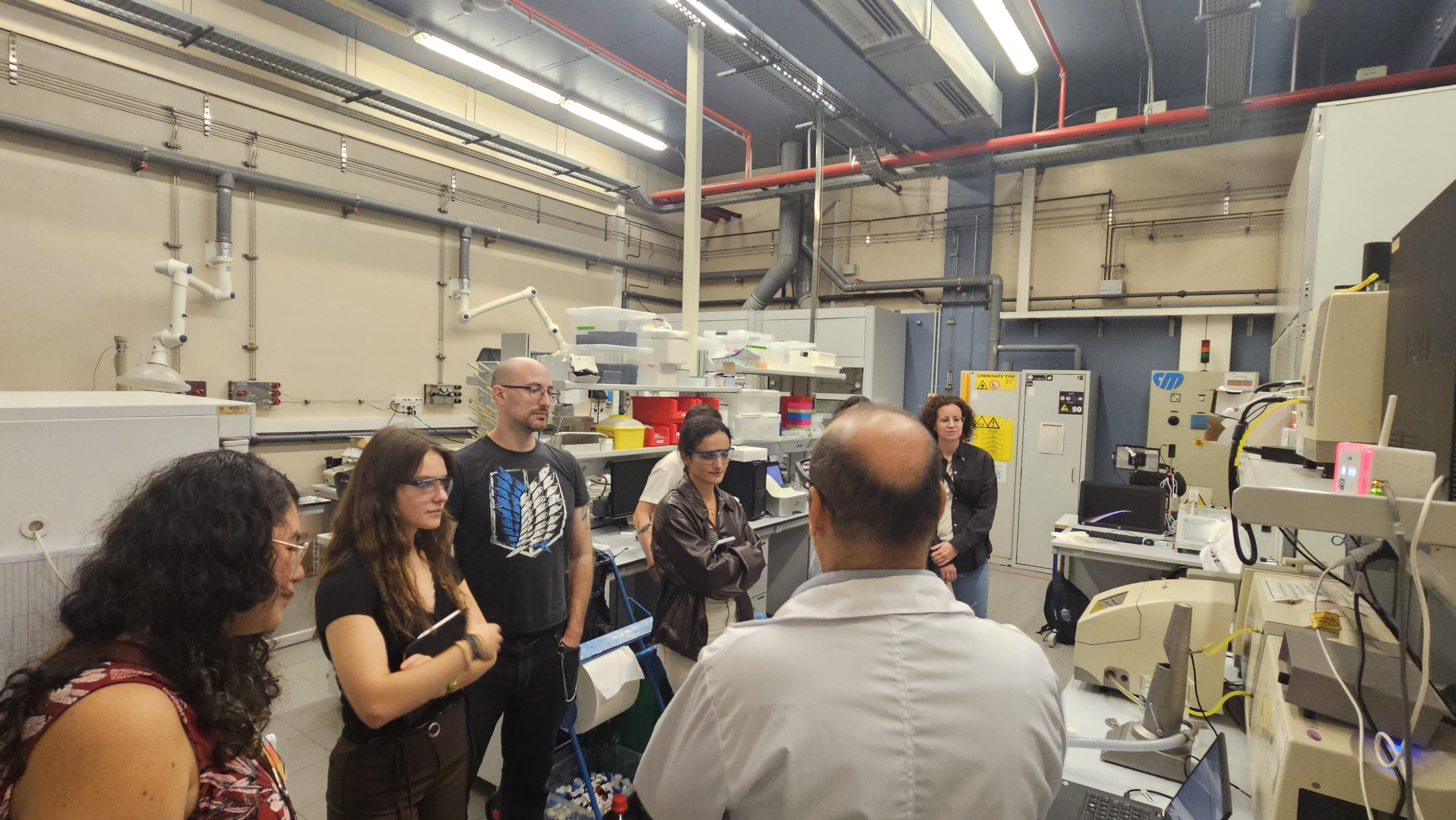
NANBIOSIS Unit 6 delivered a hands-on training course on particle characterisation techniques, covering DLS, NTA and light scattering.
Barcelona, October 2026 — From 5 to 7 October 2026, José Amable Bernabé delivered a 21-hour training course on Particle Characterisation Techniques in Bellaterra (Barcelona), highlighting the analytical capabilities available through NANBIOSIS Unit 6.
The course was organised by the Deputy General Secretariat for Human Resources in collaboration with the Institute of Materials Science of Barcelona (ICMAB-CSIC). It was aimed at scientific personnel seeking to develop practical knowledge of techniques used to characterise particulate materials, particularly researchers and staff working at ICMAB.
The programme combined theoretical sessions with hands-on training, introducing participants to three key analytical techniques:
- Dynamic Light Scattering (DLS): particle size distribution and zeta potential measurements.
- Nanoparticle Tracking Analysis (NTA): particle size distribution, particle concentration measurements and fluorescence-based analysis.
- Light Scattering (LS): particle size distribution measurements.
Practical sessions provided participants with the opportunity to analyse samples and interpret experimental results using three analytical instruments: the Zetasizer Nano ZS for DLS, the NanoSight NS300 for NTA and the Mastersizer 2000 for light scattering.
Throughout the course, the connection between these analytical services and NANBIOSIS Unit 6 was highlighted, showcasing the infrastructure’s capabilities in particle characterisation and its contribution to supporting research in materials science and nanotechnology.
Through specialised training and access to advanced analytical equipment, NANBIOSIS continues to support the scientific community in developing and applying techniques essential for the characterisation of advanced materials and nanomaterials.
NANBIOSIS Unit 6: Advanced materials for health
The poster highlights the mission of NANBIOSIS Unit 6, located at ICMAB-CSIC and coordinated by Prof. Nora Ventosa. This Unit specializes in the development, characterisation, and scale-up of molecular biomaterials with applications in biomedicine.
Equipped with state-of-the-art facilities and operating under ISO 9001 quality standards, Unit 6 offers advanced technologies such as the DELOS-SUSP method, a compressed-fluid-based process for producing highly controlled micro- and nanostructured materials. Its unique capability to scale processes from laboratory to industrial levels supports both research and technology transfer.
What is NANBIOSIS?
The goal of NANBIOSIS is to provide comprehensive and integrated advanced solutions for companies and research institutions in biomedical applications. All of this is done through a single-entry point, involving the design and production of biomaterials, nanomaterials, and their nanoconjugates. This includes their characterization from physical-chemical, functional, toxicological, and biological perspectives (preclinical validation).
If you want to collaborate with us, visit our Order Request page.
In order to access our Cutting-Edge Biomedical Solutions with priority access, enter our Competitive Call here.
NANBIOSIS has worked with pharmaceutical companies of all sizes in the areas of drug delivery, biomaterials and regenerative medicine. Here are a few of them: