



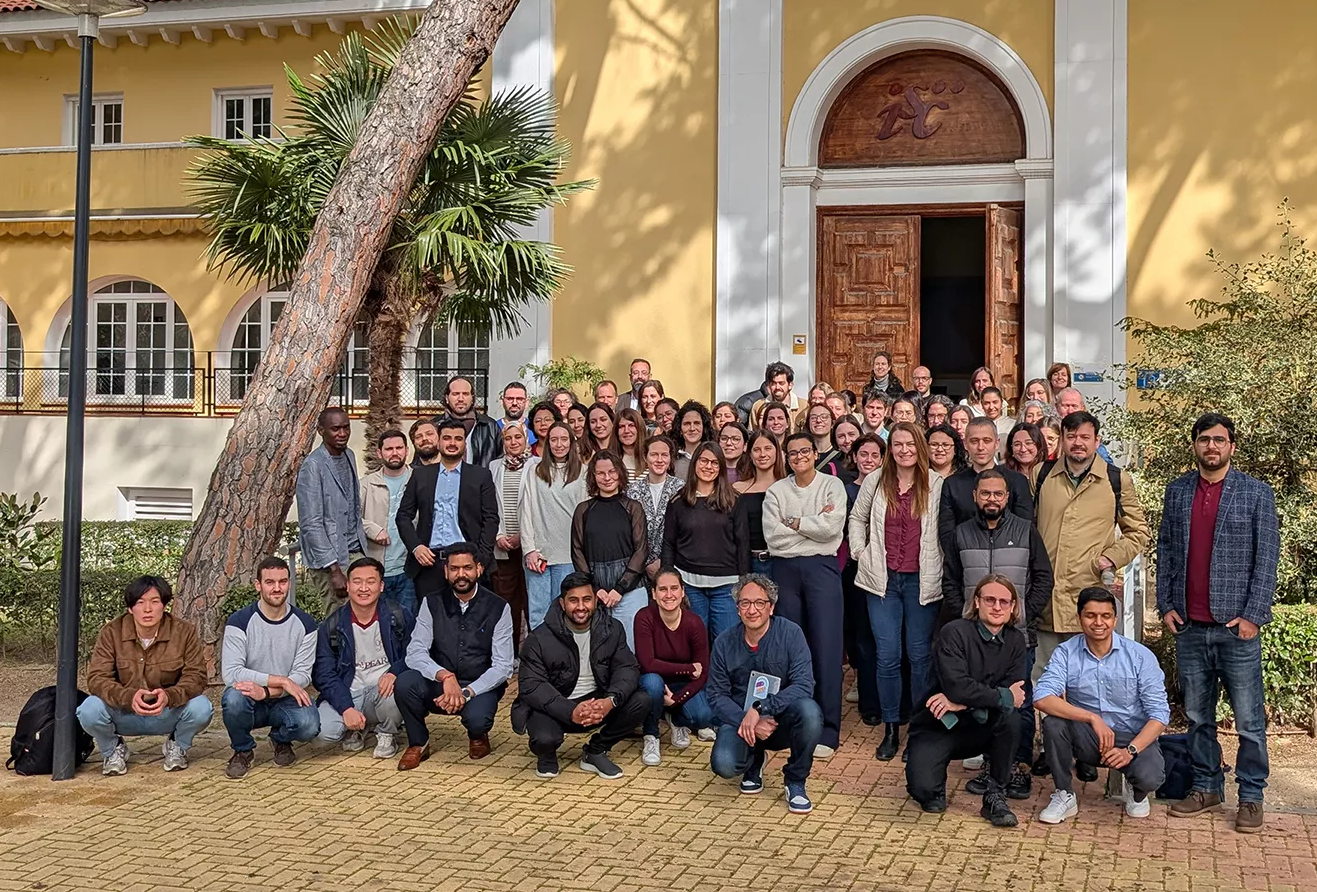
Researchers from MSCA COFUND programmes met in Madrid for a national networking event organised by FECYT and CIBER to strengthen collaboration and career development.
Madrid, March 2026 — Early-career researchers from across Spain gathered in Madrid last 4–5 March 2026 for the Inter MSCA COFUND Fellow Networking Event, a national meeting designed to strengthen collaboration, share research outcomes, and support career development within the European research ecosystem.
The event was organised by the Spanish Foundation for Science and Technology (FECYT) and the Centro de Investigación Biomédica en Red (CIBER) and took place at the headquarters of the Instituto de Salud Carlos III (ISCIII) in Madrid. It brought together researchers funded through the Marie Skłodowska‑Curie Actions (MSCA) COFUND programme as well as programme managers involved in European research initiatives, including the ARISTOS programme coordinated from CIBER.
The meeting aimed to foster collaboration between fellows from different MSCA COFUND programmes active in Spain, encourage interdisciplinary exchange, and provide guidance on research careers and European funding opportunities.
Supporting Career Development and Scientific Collaboration
The event was co-led by CIBER through the ARISTOS programme, a strategic initiative designed to promote scientific excellence and build professional networks among researchers participating in COFUND programmes.
In addition to the organisers, the Marie Curie Alumni Association (MCAA) contributed sessions focused on supporting researchers in their professional development after completing COFUND programmes.
During the first day, the coordination team of EURAXESS Spain—an initiative of the European Commission dedicated to facilitating researcher mobility and career development—led an interactive workshop on career planning. Participants explored strategies for navigating the Spanish research ecosystem and identifying future professional opportunities.
Guidance on European Research Funding
The second day focused on funding opportunities offered by the European Union. National Contact Points from FECYT’s European Office provided guidance on how to access key programmes such as:
- Marie Skłodowska‑Curie Actions Postdoctoral Fellowships (MSCA-PF)
- European Research Council (ERC)
- European Innovation Council (EIC)
Representatives from the MCAA also presented initiatives open to all MSCA fellows, including a talk by a member of the association’s Artificial Intelligence working group. The session explored how AI tools can assist researchers in preparing competitive scientific proposals.
Networking Across Scientific Disciplines
The event concluded with structured networking sessions organised into five thematic panels: Life Sciences, Chemistry, Engineering, Physics, and Social Sciences.
A total of 79 predoctoral and postdoctoral researchers from 13 different MSCA COFUND programmes participated in the meeting. Among them, 37 fellows presented their research activities, encouraging interdisciplinary discussion and the creation of new collaborations.
ARISTOS: A Strategic Programme for Biomedical Research
One of the programmes represented at the event was ARISTOS, a strategic initiative in Biomedicine and Health Sciences coordinated by CIBER. The programme offers 27 postdoctoral contracts to highly qualified researchers through a competitive selection process designed to promote international, intersectoral, and interdisciplinary research.
ARISTOS has received funding from the European Union’s Horizon Europe research and innovation programme under the Marie Skłodowska-Curie grant agreement No. 101081334.
A NANBIOSIS-Linked Researcher Among the Fellows
Among the ARISTOS fellows is Sofia Romagnoli, a biomedical engineer originally from Italy. She obtained both her Bachelor’s and Master’s degrees in Biomedical Engineering from the Università Politecnica delle Marche in 2017 and 2020, respectively, and completed her PhD there in 2024.
During her doctoral research, Romagnoli focused on bioengineering approaches to enhance athletes’ performance and safety through wearable technologies.
Following her PhD, she joined the Biomedical Signal Interpretation and Computational Simulation (BSICoS) group at the University of Zaragoza. Her current research investigates electrocardiographic biomarkers to better characterize cardiac diseases and identify arrhythmic risk.
The BSICoS group is closely connected to NANBIOSIS through Unit 27, a high-performance computing service located at the Aragon Institute of Engineering Research (I3A). This infrastructure provides advanced computational resources—including a cluster for high-performance computing, large-scale data storage, and specialised research software—to support multidisciplinary research in biomedical engineering, information and communications technologies, industrial technology, and process engineering.
Unit 27 is coordinated by Pablo Laguna, principal investigator of the Biomedical Signal Interpretation and Computational Simulation (BSICoS) group.
Read the original Spanish article here.
Part of the event was published as a recorded session that can be watched here.
What is NANBIOSIS?
The goal of NANBIOSIS is to provide comprehensive and integrated advanced solutions for companies and research institutions in biomedical applications. All of this is done through a single-entry point, involving the design and production of biomaterials, nanomaterials, and their nanoconjugates. This includes their characterization from physical-chemical, functional, toxicological, and biological perspectives (preclinical validation).
If you want to collaborate with us, visit our Order Request page.
In order to access our Cutting-Edge Biomedical Solutions with priority access, enter our Competitive Call here.
NANBIOSIS has worked with pharmaceutical companies of all sizes in the areas of drug delivery, biomaterials and regenerative medicine. Here are a few of them: